
How Can I Reduce Warehouse Dock Congestion and Truck Wait Times?
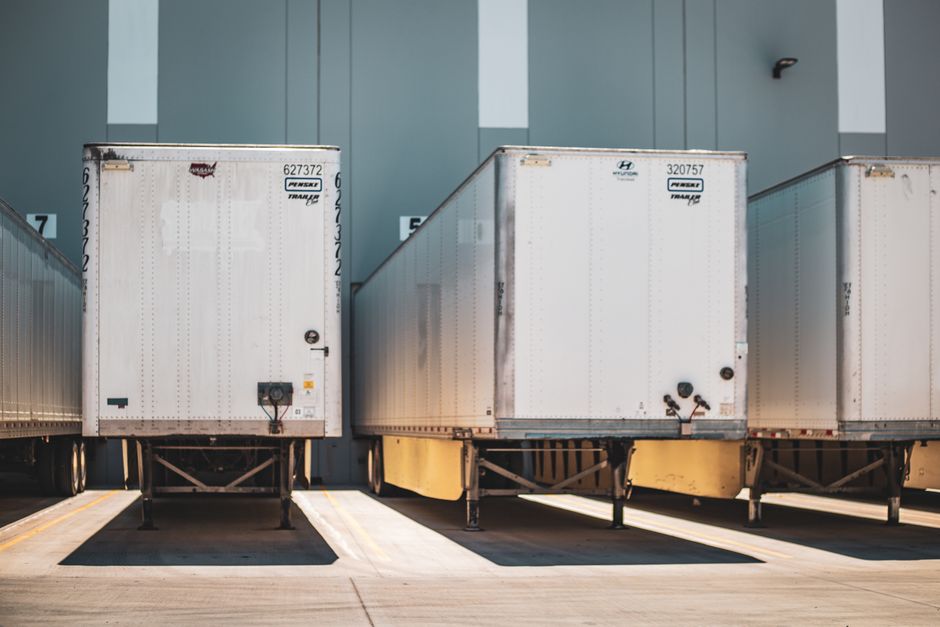
Reduce dock congestion by measuring each step from arrival to departure, then match appointment slots, dock assignments, and labor to the actual arrival pattern. Record check-in time, queue length, unloading time, dock time, and truck turnaround; capture schedule changes in a shared system; and use updated arrival estimates to adjust assignments. Review the measures regularly to find where delays are forming.
Why do trucks wait so long at warehouse docks?
Trucks wait when arrivals bunch up faster than the warehouse can check them in or process them at available docks. That distinction matters: a visible line at the gate may start with too few check-in staff, while a long wait after check-in may point to a shortage of unloading capacity or labor.
Map the truck journey in stages: arrival, check-in, queue, dock assignment, unloading or loading, and departure. The study by Dustin Smith and Sharan Srinivas in Simulation Modelling Practice and Theory identifies check-in processing time, truck waiting time, queue length, loading and unloading time, dock time, and the number of dock doors as useful measures. It defines truck turnaround as the time from arrival to departure.
The study’s 2016 case illustrates why stage-level measurement matters: average check-in waiting was 53.3 ± 20.8 minutes, compared with 28.8 ± 22.5 minutes for loading and unloading. Those figures describe that company and year, not a universal benchmark. The same paper identifies staff shortages and incomplete or incorrect inbound documents as causes of check-in delay, so a dock-door count alone cannot explain the queue.
Build a simple time-stamped log. For every truck, capture arrival, check-in start and finish, dock arrival, unloading start and finish, and departure. Then group the results by time of day, shipment type, and appointment status. A recurring rise in check-in time during a peak points to a different fix than rising dock dwell while check-in remains steady.
How do I schedule warehouse deliveries to avoid congestion?
Schedule deliveries by spreading expected arrivals across the hours when check-in, docks, and unloading labor can handle them. An appointment slot is only useful if the operation can see and respond to changes.
Start with the arrival log: identify periods when demand regularly exceeds service capacity, then avoid stacking appointments into those windows unless the necessary labor and dock space are available. Set each slot against realistic processing capacity, and make the appointment rules clear to carriers: what information to submit, when to report delays, and how to request a new time.
Next, make the schedule a shared, current record. A 2023 distribution-center case study in Frontiers in Energy Research reported dock-booking compliance of about 65% at distribution centers and 19% at factories. In its case company, roughly 5% of booking requests were recorded as rescheduled or canceled in the transport system, while actual amendments were around 45%. The gap shows why recording changes matters: a schedule that looks stable can hide a very different arrival plan.
Use a short rescheduling script with carriers and internal teams: “Your estimated arrival has changed. Please confirm the updated ETA and requested slot in the shared system so receiving can adjust the dock and labor plan.” The Frontiers study identifies real-time data integration, automated scheduling, dynamic responsiveness, and coordination between departments as requirements for intelligent dock booking. It also discusses tracking cancellations, planning time, loading and unloading space utilization, and truck-processing duration.
Reservations can help distribute arrivals, but results depend on participation and the outcome being measured. Piet Zeegers’s Delft University of Technology simulation of Royal FloraHolland’s Aalsmeer operation found gains emerging at approximately 70% reservation participation. In the modeled scenarios, maximum trolley throughput time to cooled storage fell by up to 18%, while dock times did not decrease significantly. In other words, smoothing arrivals may improve downstream flow even when time at the dock itself changes little.
How can a warehouse reduce detention fees and truck wait times?
Reduce detention and waiting by acting on the measured cause: add check-in capacity when the gate is the constraint, shift unloading labor when dock service is the constraint, and update slots when arrivals move. Keep these actions tied to the same operating measures so a fix in one stage does not merely push the queue to another.
First, review the queue and dwell measures by time window. If arrivals outpace check-in, adjust check-in coverage for that peak and verify that inbound documents are complete before the truck arrives. If check-in is moving but trucks wait for doors or unloading crews, align dock assignments and staffing with the expected shipment volume.
Second, use estimated arrival times to adapt appointments. A Winter Simulation Conference study by Vanga, Maknoon, Tavasszy, and Gelper modeled real-time truck arrival information under traffic-related uncertainty. Across its simulation scenarios, ETA information improved average truck waiting time by 20–21%; truck turn time improved by 19 minutes (13%) in the flexible scenario and 26 minutes (17%) in the restrictive scenario. These are modeled results, not a guarantee for every facility, but they support updating slots as arrival estimates change.
Third, plan staffing in two stages. A Politecnico di Milano thesis on workforce sizing under truck-arrival uncertainty describes planning regular staffing before arrivals are known, then scheduling unloading once actual arrivals are observed. In instances generated from postal distribution-center data, accounting for uncertainty increased staffing by 12%, reduced overtime costs by 55.4% versus a plan that ignored uncertainty, and finished operations 1.5 hours earlier. The thesis also found that scheduling arrivals earlier in the shift reduced modeled total costs by 1.33% versus uniform scheduling. These findings are case-model results; use them as evidence for testing an uncertainty-aware plan, not as promised savings.
Use a compact dashboard to keep the response practical:
| Measure | What it tells you | Operational response |
|---|---|---|
| Arrival volume by time window | When demand concentrates | Spread slots or shift coverage to match the pattern |
| Check-in time and queue length | Whether the entry process is constraining flow | Review check-in coverage and document readiness |
| Wait after check-in | Whether trucks are waiting for a dock or unloading crew | Rebalance dock assignments and labor |
| Dock and unloading time | How long capacity remains occupied | Compare by shipment and process type |
| Arrival-to-departure turnaround | Total truck time on site | Check whether changes reduce end-to-end delay |
| Appointment changes and cancellations | Whether the live plan differs from the booking record | Capture amendments in the shared system |
Detention exposure makes the dashboard worth maintaining. Smith and Srinivas report detention rates of $15–$90 per hour and typical free periods of one to two hours, varying by carrier. Their 2016 case company paid about $1.65 million in detention fees that year. Use each carrier’s actual terms when estimating exposure; the published range is context, not a rate to assume for every shipment.
Run one weekly review: identify the time window with the longest queue, name the stage where delay accumulates, and choose one staffing, appointment, or document-readiness adjustment to test. Record the result against the same measures the following week. That gives the team a specific next move instead of a general instruction to “clear the dock faster.”
Frequently Asked Questions
What metrics help identify a receiving dock bottleneck?
Track check-in processing time, truck waiting time, queue length, loading or unloading time, dock time, dock-door count, and arrival-to-departure turnaround. Compare these measures by time period and look for where queues or dwell build up. Add cancellations, planning time, and space utilization to understand how appointment changes affect the operation.
How should warehouse labor be scheduled around inbound deliveries?
Use expected arrivals to plan regular staffing before the shift, then assign unloading work as actual arrival information becomes available. Build the plan around arrival patterns and dock capacity rather than treating every hour as equally busy. Review overtime and end-of-shift completion to see whether the plan is absorbing uncertainty.
Sources
- Dustin Smith and Sharan Srinivas, Simulation Modelling Practice and Theory
- Frontiers in Energy Research (2023 distribution-center dock-booking case study)
- Piet Zeegers, Delft University of Technology Repository, Dock Reservation Arrival Patterns and Scheduling
- Vanga, Maknoon, Tavasszy, and Gelper, Winter Simulation Conference, Effect of Real-Time Truck Arrival Information on the Resilience of Slot Management Systems
- Politecnico di Milano Repository, Stochastic Workforce Sizing under Truck Arrival Uncertainty in Distribution Centers
You may also like

Where Can Small Contractors Find Reliable Construction Workers?
Compare hiring channels, screen for reliability, and build a steady pipeline of construction workers with clear job details and structured training.

Choose a Fuel Card That Saves Your Small Fleet Money
Compare fuel-card coverage, fees, rebates, controls, and reporting to choose a practical card for a small fleet.

How Do I Start a Transportation Business the Right Way?
A practical guide to choosing a transportation niche, handling registrations, budgeting startup costs, and setting profitable rates.

How Do I Vet a Renovation Contractor in Toronto Before Signing?
A practical Toronto checklist for comparing renovation quotes, confirming permits, and verifying WSIB, insurance, and trade credentials.